

AI automation is worth it for many small businesses in 2026, especially those looking to improve efficiency, reduce repetitive work, generate more leads, and scale operations without significantly increasing payroll costs. While automation requires an upfront investment, the long-term savings and productivity gains often deliver a strong return on investment.
The key question is not whether AI automation works—it does. The real question is whether your business has processes that can benefit from automation. For most small businesses, the answer is yes.
Considering AI Automation for Your Business?
Binary Ideas Local Marketing
9525 4th Place, Lorton, VA 22079
Phone: (703) 690-9726
Map:
If you’re exploring AI automation and want to understand whether it’s a smart investment for your business, a strategy consultation can help identify where automation can create the greatest impact. Business information sourced from company records.
What Is AI Automation?

AI automation uses artificial intelligence to perform tasks that normally require human effort. Unlike traditional software that follows fixed rules, AI-powered systems can analyze information, make decisions, learn patterns, and automate workflows.
Examples of AI automation for small businesses include:
- Automated lead qualification
- Appointment scheduling
- Customer service chatbots
- Email follow-up sequences
- Review generation systems
- CRM automation
- Marketing campaign optimization
- Reporting and analytics automation
In simple terms, AI automation helps businesses accomplish more work with fewer manual tasks.
For a small business owner, this means spending less time on administrative work and more time focusing on growth, customer relationships, and revenue-generating activities.
How AI Automation Works
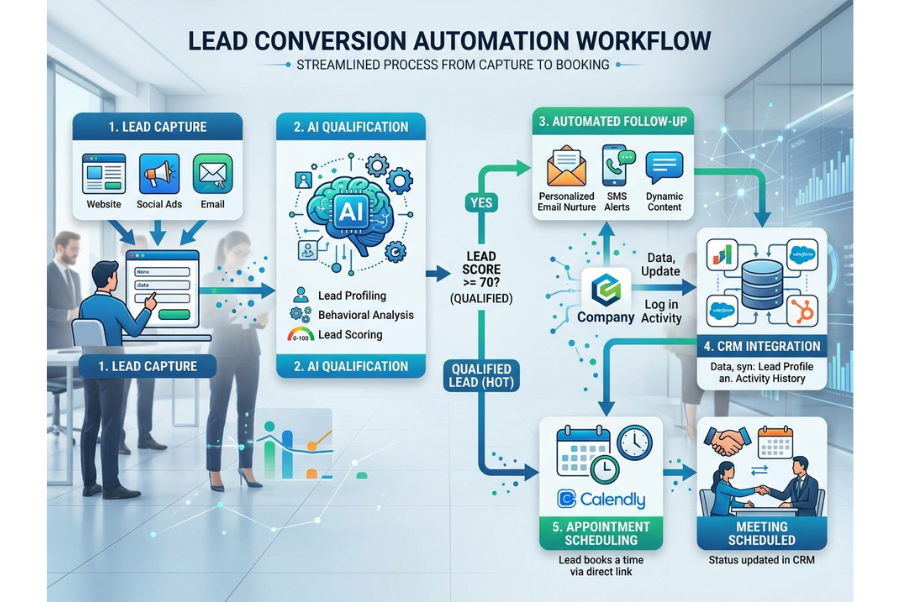
AI automation starts by identifying repetitive processes that consume time and resources.
A typical automation workflow might look like this:
- A prospect fills out a website form.
- AI evaluates the lead quality.
- The prospect receives an instant response.
- The CRM is automatically updated.
- Follow-up emails and reminders are triggered.
- The sales team receives notifications.
Without automation, an employee would manually perform each step.
With AI automation, the entire process can happen within seconds, reducing delays and improving customer experience.
For example, a local contractor receiving 20 leads per week may spend several hours manually contacting prospects. An automated system can immediately engage new leads, increasing response speed and reducing the risk of losing opportunities to competitors.
Now that you understand how AI automation works, let’s examine what it costs.
How Much Does AI Automation Cost for Small Businesses?
The cost of AI automation varies depending on complexity, business size, and implementation requirements.
Typical pricing ranges include:
| Solution Type | Typical Cost |
| Basic AI tools | $20–$200/month |
| AI chatbots | $100–$1,000/month |
| Marketing automation platforms | $100–$2,500/month |
| Custom AI workflows | $1,000–$10,000+ setup |
| Enterprise-level automation | $10,000+ |
Several factors influence pricing:
- Number of workflows automated
- Software integrations required
- Custom development needs
- Ongoing management and optimization
- Industry-specific requirements
A common concern among small business owners is affordability. However, comparing automation costs against employee labor often provides a clearer perspective.
For example, if automation saves 20 hours per month and employee costs average $25 per hour, the business saves approximately $500 monthly in labor costs alone.
AI Automation Options for Small Businesses
Not every business requires a fully customized AI system. There are several options available depending on goals and budget.
Option 1: Standalone AI Tools
Businesses can use tools such as AI writing assistants, customer service platforms, and scheduling software.
Pros:
- Low cost
- Easy setup
- Quick implementation
Cons:
- Limited customization
- May not integrate with existing systems
Option 2: Marketing Automation Platforms
These platforms automate lead nurturing, email marketing, and customer communication.
Pros:
- Strong lead generation support
- Improved follow-up consistency
Cons:
- Learning curve
- Subscription costs
Option 3: Custom AI Automation Systems
Custom systems connect multiple tools into one automated workflow.
Pros:
- Tailored to business processes
- Maximum efficiency
- Better scalability
Cons:
- Higher upfront investment
For many small businesses, a combination of marketing automation and customized workflows delivers the best balance between cost and performance.
Is AI Automation Worth It? Understanding ROI
When evaluating AI automation, ROI should be the primary decision factor.
Potential benefits include:
Increased Productivity
Employees spend less time on repetitive tasks and more time on strategic work.
For example:
- Automated appointment reminders
- Automated lead follow-up
- Automated data entry
These efficiencies can save dozens of hours each month.
Better Lead Conversion Rates
Speed matters in lead generation.
Research consistently shows that faster response times increase conversion rates significantly. AI systems can respond instantly, even outside business hours.
This creates opportunities that would otherwise be missed.
Lower Operational Costs
Many businesses initially invest in automation to reduce overhead.
Instead of hiring additional administrative staff, automation can often handle:
- Scheduling
- Follow-ups
- Customer inquiries
- Reporting
The result is lower operational costs while maintaining service quality.
Example ROI Calculation
Consider a small business owner who spends 20 hours per month manually responding to leads, scheduling appointments, and updating customer records.
- Labor cost: $25 per hour
- Time saved: 20 hours per month
- Monthly savings: $500
- Annual savings: $6,000
If the business invests $250 per month in AI automation ($3,000 annually), the net annual gain is approximately $3,000 before accounting for additional revenue generated through improved lead conversion and faster response times.
This simple example demonstrates why many businesses view automation as a profit-generating investment rather than just another expense.
Scalability Without Additional Payroll
One of the biggest advantages of AI automation is scalability.
A business that receives 50 leads per month may eventually receive 500.
Automation allows growth without increasing staffing at the same rate.
This is often where the largest ROI occurs because operational costs remain relatively stable while lead volume and revenue increase.
Real-World Example
Imagine a local service business generating 100 leads monthly.
Without automation:
- Staff manually follow up
- Some leads are missed
- Response times vary
With automation:
- Every lead receives immediate contact
- Follow-up sequences run automatically
- Staff focus on closing sales
If automation improves lead conversion by just 5%, the business could generate dozens of additional customers each year. For many small businesses, even a modest increase in conversion rates can translate into thousands of dollars in additional annual revenue, making automation a worthwhile long-term investment.
What to Expect When Implementing AI Automation
Many business owners expect immediate results.
While some improvements occur quickly, successful automation usually follows this timeline:
Month 1
- Process analysis
- Workflow setup
- Software integration
Months 2–3
- Optimization
- Employee adoption
- Initial performance improvements
Months 4–6
- Measurable productivity gains
- Improved lead management
- Increased operational efficiency
The businesses that achieve the best results view automation as a long-term investment rather than a quick fix.
How to Choose an AI Automation Provider
Choosing the right provider can significantly impact ROI.
Look for providers that:
- Understand your industry
- Offer custom workflow design
- Provide ongoing support
- Integrate with existing systems
- Demonstrate measurable results
Questions to ask include:
- What processes can be automated?
- What ROI can reasonably be expected?
- What integrations are available?
- How long does implementation take?
- What support is included?
Avoid providers that promise unrealistic results or fail to explain how automation will support your business goals.
Key Takeaways
- AI automation can significantly improve efficiency for small businesses.
- Costs vary from affordable monthly subscriptions to custom implementations.
- The greatest ROI often comes from time savings, improved lead management, and scalability.
- Businesses with repetitive processes typically see the strongest results.
- Success depends on selecting the right tools and implementation strategy.
Frequently Asked Questions
Is AI automation worth it for very small businesses?
Yes. Even businesses with only a few employees can benefit from automating repetitive tasks such as scheduling, customer communication, and lead follow-up.
How long does it take to see ROI from AI automation?
Many businesses begin seeing measurable efficiency improvements within 2–3 months, while larger ROI gains often appear within 6–12 months.
What industries benefit most from AI automation?
Home services, healthcare, legal firms, professional services, contractors, real estate companies, and local service businesses often see significant value from automation.
Can AI automation replace employees?
In most cases, AI automation complements employees rather than replaces them. It removes repetitive work so staff can focus on higher-value activities.
What is the biggest risk of AI automation?
The biggest risk is implementing automation without a clear strategy. Poorly designed workflows can create inefficiencies instead of solving them.
Conclusion
So, is AI automation worth it for small businesses in 2026? For most businesses, the answer is yes.
Companies that automate repetitive tasks, improve lead response times, and streamline operations often gain a competitive advantage while reducing operational costs. The key is choosing the right automation strategy based on your business goals, budget, and growth plans.
If you’re ready to explore how AI automation can improve efficiency and generate more leads, contact Binary Ideas Local Marketing today.
Binary Ideas Local Marketing
9525 4th Place, Lorton, VA 22079
Phone: (703) 690-9726
Website: https://binaryideas.com/
Contact: https://binaryideas.com/contact-us/
Suggested Internal Links
- What Is AI Automation for Businesses and How It Drives More Leads
- What Does an AI Automation Agency Do and How It Increases ROI
- AI Automation Services: https://binaryideas.com/ai-automation/