

If you’re wondering SEO vs Google Ads: which is better for your local business, the answer depends largely on your goals, budget, and how quickly you need results. Google Ads typically delivers faster ROI because campaigns can begin generating leads within days, while SEO often requires several months to build momentum. However, SEO can generate a higher long-term return once rankings are established.
For local businesses looking to maximize marketing performance, understanding the differences between speed, cost, scalability, and long-term value is essential before investing your budget.
Looking for a Marketing Strategy That Maximizes ROI?
Binary Ideas Local Marketing helps local businesses generate leads through Local SEO, Google Ads, AI Automation, and conversion-focused digital marketing strategies.
Binary Ideas Local Marketing
9525 4th Place, Lorton, VA 22079
(703) 690-9726
Whether you need immediate lead generation or a long-term growth strategy, understanding the strengths of SEO and Google Ads can help you make a more informed decision.
What Is the Difference Between SEO and Google Ads?
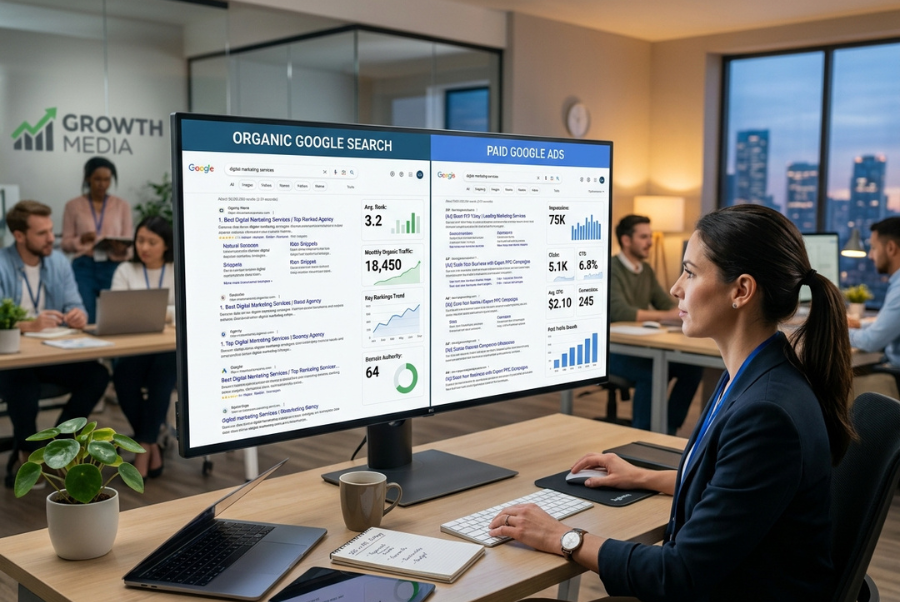
SEO (Search Engine Optimization) is the process of improving your website’s visibility in Google’s organic search results. The goal is to increase rankings, attract qualified traffic, and generate leads without paying for every click.
Google Ads is Google’s pay-per-click advertising platform that allows businesses to appear at the top of search results immediately. Advertisers bid on keywords and pay whenever someone clicks their ad.
Although both channels help customers find your business online, they achieve that goal in different ways.
SEO Benefits
- Builds long-term visibility
- Increases website authority
- Generates ongoing organic traffic
- Improves trust and credibility
- Reduces acquisition costs over time
Google Ads Benefits
- Generates traffic immediately
- Provides precise targeting
- Offers predictable lead volume
- Delivers measurable performance data
- Scales quickly with increased budgets
A simple way to think about it is this:
SEO builds a long-term marketing asset.
Google Ads buys immediate attention.
How SEO and Google Ads Work

Now that you understand the basic difference, let’s examine how each strategy produces leads and ROI.
How SEO Works
SEO involves optimizing multiple aspects of your online presence, including:
- Website content
- Technical SEO
- Google Business Profile
- Local citations
- Backlinks
- User experience
For example, if someone searches “emergency plumber near me,” strong SEO can help your business appear in the local map pack and organic search results.
Over time, improved rankings increase website traffic, phone calls, and lead submissions without requiring payment for each visitor.
How Google Ads Works
Google Ads allows businesses to place paid advertisements above organic search results.
Advertisers select:
- Target keywords
- Geographic locations
- Daily budgets
- Ad copy
- Landing pages
Once campaigns are launched, ads can begin generating clicks and leads immediately.
For example, a roofing company can start receiving estimate requests within days by targeting high-intent keywords such as “roof replacement near me.”
This immediate visibility is why many businesses choose Google Ads when speed is the primary objective.
SEO vs Google Ads Cost and Pricing

Cost plays a major role in determining ROI. Understanding the investment required for each strategy helps businesses make more informed decisions.
Typical SEO Costs
Most local businesses invest:
| SEO Campaign Type | Monthly Cost |
| Basic Local SEO | $500–$1,500 |
| Competitive Markets | $1,500–$3,500 |
| Aggressive Growth Campaigns | $3,500–$10,000+ |
Factors affecting SEO pricing include:
- Market competition
- Service area size
- Website condition
- Content requirements
- Link acquisition efforts
- Technical improvements
Typical Google Ads Costs
Google Ads budgets vary based on industry and competition.
| Business Type | Monthly Ad Spend |
| Small Local Business | $500–$2,000 |
| Growing Business | $2,000–$5,000 |
| Competitive Industries | $5,000–$20,000+ |
Many businesses also pay management fees ranging from $300 to $2,000+ per month.
Cost Recovery Timeline
One of the biggest differences between SEO and Google Ads is how quickly businesses recover their investment and begin seeing measurable returns.
Google Ads
- Leads can begin arriving within days of launching a campaign
- ROI can become positive within weeks if campaigns are properly optimized
- Performance data is available immediately, allowing rapid adjustments
- Businesses can scale lead generation quickly by increasing budget
Because Google Ads produces immediate visibility, it is often the preferred option for businesses that need leads, appointments, or sales as quickly as possible.
SEO
- Initial investments focus on website optimization, content creation, and authority building
- Significant ranking improvements often take 3–6 months
- Positive ROI commonly appears between months 6–12
- Long-term acquisition costs typically decrease as organic visibility grows
Although SEO requires patience, the long-term payoff can be substantial because businesses continue receiving traffic and leads without paying for every click.
Example: $2,000 Monthly Marketing Budget
To better understand the difference, imagine two local businesses each invest $2,000 per month in marketing.
Business A invests in Google Ads.
- Campaign launches immediately
- Leads begin arriving within the first few weeks
- Average cost per lead is $50
- Approximately 40 leads are generated per month
- ROI can be measured almost immediately
However, if advertising stops, lead flow typically stops as well.
Business B invests in SEO.
- Initial months focus on content creation and optimization
- Lead volume starts slowly while rankings improve
- Organic traffic begins increasing around months 4–6
- By months 9–12, rankings generate a consistent stream of leads
- Cost per lead often decreases significantly over time
Unlike Google Ads, SEO continues generating value long after the initial optimization work is completed.
Key Insight
If your primary goal is the fastest possible ROI, Google Ads is usually the better choice because it can generate measurable results within days or weeks.
If your goal is maximizing long-term ROI and lowering customer acquisition costs, SEO often becomes the stronger investment over time.
This is why many successful local businesses combine both strategies—using Google Ads to generate immediate leads while building SEO authority for sustainable growth and higher long-term returns.
Options and Alternatives: Which Strategy Fits Your Goals?
The right choice depends on your objectives, budget, and timeline.
Choose SEO If:
- You want long-term growth
- You prefer sustainable lead generation
- You want to reduce future advertising costs
- You can wait several months for results
SEO works particularly well for:
- Law firms
- Medical practices
- Contractors
- Home service companies
- Professional service businesses
Choose Google Ads If:
- You need leads immediately
- You’re launching a new business
- You want predictable lead volume
- You need fast market validation
Google Ads often performs best for:
- Emergency services
- Seasonal businesses
- High-ticket service providers
- Businesses entering new markets
Choose Both If:
Many successful businesses eventually combine SEO and Google Ads.
Google Ads generates immediate leads while SEO builds long-term authority and organic visibility. Together, they create a more balanced and resilient lead generation system.
Which One Gives Faster ROI?
This is the most important question for many local business owners.
Google Ads: Faster Initial ROI
Google Ads typically provides the fastest path to measurable ROI.
A campaign can be launched within days and begin generating phone calls, form submissions, and appointments almost immediately.
Businesses can quickly identify:
- Cost per lead
- Conversion rates
- Return on ad spend
- Revenue generated
For companies needing immediate growth, this speed can be extremely valuable.
SEO: Slower Start, Stronger Long-Term ROI
SEO generally requires patience.
It often takes:
- 3–6 months to gain traction
- 6–12 months to see significant growth
- 12+ months to establish market authority
However, once rankings improve, organic traffic can continue producing leads without paying for every click.
This is why many businesses eventually achieve lower customer acquisition costs through SEO.
Real-World Scenario
Imagine two businesses each invest $2,000 per month.
Business A Uses Google Ads
- Leads arrive within days
- ROI becomes measurable quickly
- Costs continue for every lead generated
Business B Uses SEO
- Leads arrive more slowly
- Rankings improve gradually
- Traffic continues growing over time
After two years, Business B may generate comparable or higher lead volume while spending less per acquisition.
ROI Speed Comparison
| Metric | Google Ads | SEO |
| Time to Launch | Days | Weeks |
| Time to First Lead | Days | Months |
| Time to Positive ROI | Weeks to Months | Months |
| Long-Term ROI | Moderate to High | High |
| Scalability | High | High |
| Traffic Stops When Spending Stops | Yes | No |
For businesses focused solely on speed, Google Ads generally wins.
For businesses focused on long-term efficiency, SEO often delivers superior returns.
What to Expect From Each Strategy
Understanding realistic timelines helps set proper expectations.
SEO Timeline
Months 1–2
- Research and strategy
- Technical improvements
- Content optimization
Months 3–6
- Ranking improvements
- Increased website visibility
- Initial lead growth
Months 6–12
- Stronger organic traffic
- Improved lead quality
- Better ROI
Google Ads Timeline
Week 1
- Campaign setup
- Keyword targeting
- Landing page optimization
Weeks 2–4
- Initial leads
- Performance data collection
Months 2–3
- Campaign optimization
- Improved ROI
Months 3+
- Scalable lead generation
- Predictable performance
Businesses seeking fast results typically prefer Google Ads, while businesses focused on sustainable growth often prioritize SEO.
How to Choose the Right Marketing Provider
Whether you invest in SEO, Google Ads, or both, selecting the right provider significantly impacts ROI.
Look for agencies that:
- Focus on revenue and lead generation
- Provide transparent reporting
- Track conversions accurately
- Understand local markets
- Offer strategic recommendations
Avoid providers that:
- Guarantee rankings
- Promise instant SEO success
- Focus only on traffic metrics
- Refuse to discuss conversion tracking
A quality provider should help you understand exactly how marketing investments contribute to business growth.
Key Takeaways
- Google Ads typically delivers faster ROI.
- SEO usually produces stronger long-term ROI.
- Google Ads is ideal for immediate lead generation.
- SEO builds sustainable visibility and authority.
- Many businesses achieve the best results by combining both.
- The right choice depends on budget, timeline, and growth goals.
Frequently Asked Questions
Which strategy produces ROI faster?
Google Ads usually produces ROI faster because campaigns can generate leads immediately after launch. SEO requires more time to build rankings and visibility before delivering significant results.
Is SEO better than Google Ads?
Not necessarily. Google Ads is typically better for immediate lead generation, while SEO is often better for long-term growth and lower acquisition costs.
How long does SEO take to outperform Google Ads?
In many industries, SEO begins outperforming Google Ads on cost per lead after 12–24 months, depending on competition, market demand, and content quality.
Is Google Ads worth it for small businesses?
Yes. When campaigns are properly managed, Google Ads can generate highly targeted leads and provide measurable ROI quickly.
Should local businesses use SEO and Google Ads together?
In many cases, yes. Combining both strategies allows businesses to generate immediate leads while simultaneously building long-term organic visibility.
SEO vs Google Ads: Which Is Better for Local Businesses?
Neither strategy is universally better. Google Ads typically delivers faster results and immediate lead generation, while SEO often produces stronger long-term ROI and lower acquisition costs. The best choice depends on your business goals, budget, timeline, and competitive market.
Conclusion
When comparing SEO vs Google Ads: Which One Gives Faster ROI for Local Businesses, Google Ads is typically the faster option. Businesses can begin generating leads within days and often see measurable returns within the first few months.
SEO requires more patience, but it frequently delivers stronger long-term ROI because rankings continue generating traffic, leads, and visibility without paying for every click. Over time, this can significantly reduce customer acquisition costs and create a more sustainable growth engine.
For most local businesses, the best strategy is not choosing one over the other. The most effective approach is often using Google Ads to generate immediate leads while building SEO authority that drives long-term growth and profitability.
Ready to determine whether SEO, Google Ads, or a combination of both will generate the fastest ROI for your business? Contact Binary Ideas Local Marketing to discuss your goals and develop a customized strategy based on your budget, competition, and growth objectives.
Contact Us: https://binaryideas.com/contact-us/
Binary Ideas Local Marketing
9525 4th Place, Lorton, VA 22079
(703) 690-9726
Schedule your consultation today and discover how the right marketing strategy can help your business generate more leads, increase revenue, and maximize long-term return on investment.
Internal Resources
- What Is Local SEO and How It Helps You Rank and Get More Leads
- How Do Google Ads Work for Local Businesses
- How Much Does SEO Cost Per Month and What Determines Pricing
External Resources
- Google Search Central: https://developers.google.com/search
- U.S. Small Business Administration Marketing Resources: https://www.sba.gov
HubSpot Marketing Research: https://www.hubspot.com/resources