

Understanding how AI improves Google Ads performance is becoming increasingly important for businesses that want to generate more qualified leads while keeping advertising costs under control. Artificial intelligence analyzes massive amounts of campaign data in real time, enabling Google Ads to optimize bids, audiences, keywords, and ad placements more efficiently than manual management alone.
Instead of relying on guesswork or constant manual adjustments, AI identifies patterns that humans may overlook. The result is often better click-through rates, higher-quality leads, improved conversion rates, and a lower cost per acquisition. For businesses competing in crowded industries, these improvements can make a significant difference in overall marketing ROI.
Whether you’re running a small local campaign or managing a larger multi-location advertising strategy, understanding how AI works inside Google Ads can help you make smarter marketing decisions and improve long-term advertising performance.
Looking to Improve Your Google Ads Performance?
If you’re looking for ways to generate higher-quality prospects while reducing wasted ad spend, AI-powered Google Ads management can help optimize campaigns using real-time data and machine learning.
Binary Ideas Local Marketing
Address: 9525 4th Place, Lorton, VA 22079
Phone: (703) 690-9726
What Does AI Do in Google Ads?

Artificial intelligence in Google Ads refers to Google’s machine learning systems that automatically analyze billions of signals every day to improve campaign performance. Rather than requiring advertisers to manually adjust every bid, keyword, audience, and placement, AI continuously learns from user behavior and campaign data to make intelligent optimization decisions.
Google’s AI evaluates factors such as:
- User search intent
- Device type
- Geographic location
- Time of day
- Previous browsing behavior
- Historical conversion data
- Audience interests
- Demographic information
- Competition levels
- Landing page relevance
Instead of making decisions based on one or two variables, AI processes hundreds of signals simultaneously before determining the best opportunity to display an advertisement.
For example, two people may search for exactly the same keyword, but Google’s AI may decide to bid more aggressively for one user because historical data suggests they are significantly more likely to become a customer.
This level of prediction would be nearly impossible to perform manually at scale.
Why Traditional Google Ads Management Has Limitations
Many businesses still manage Google Ads using mostly manual processes. While manual optimization can work for smaller campaigns, it becomes increasingly difficult as campaigns grow more complex.
Some common challenges include:
- Monitoring hundreds or thousands of keywords
- Adjusting bids multiple times per day
- Identifying underperforming search terms
- Segmenting audiences accurately
- Managing multiple campaigns simultaneously
- Responding quickly to changing market conditions
Even experienced PPC specialists cannot review every auction or predict every conversion opportunity in real time.
Markets change constantly. Competitors adjust budgets, customer behavior shifts, and search trends evolve daily. Manual optimization often reacts after changes occur, while AI continuously adapts as new information becomes available.
This ability to respond instantly is one of AI’s biggest advantages.
How AI Improves Google Ads Performance
Artificial intelligence enhances nearly every stage of a Google Ads campaign. Rather than replacing marketing strategy, AI strengthens campaign execution by making faster and more accurate optimization decisions based on real-world performance data.
This continuous learning process is one reason AI PPC optimization has become increasingly valuable for businesses that want to improve campaign efficiency while maintaining control over advertising budgets.
Several areas benefit significantly from AI-driven optimization.
Smarter Bid Management
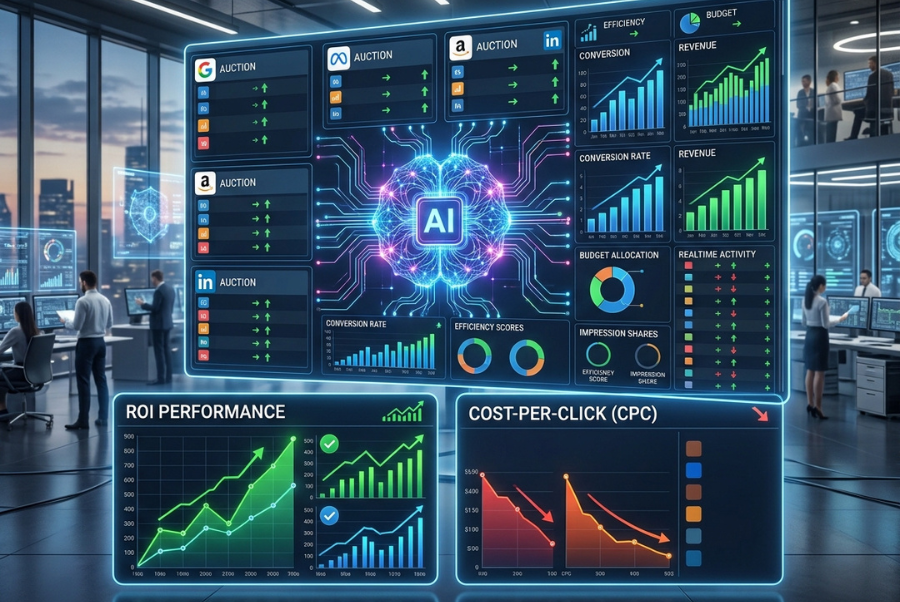
One of the most powerful applications of AI is automated bidding.
Instead of setting fixed keyword bids, Google’s Smart Bidding strategies evaluate every auction individually. AI estimates the likelihood that a particular search will result in a conversion and adjusts bids accordingly.
Common Smart Bidding strategies include:
- Target CPA
- Target ROAS
- Maximize Conversions
- Maximize Conversion Value
Because these decisions happen during every auction, advertisers can compete more effectively without manually adjusting bids throughout the day.
For businesses focused on lead generation, this often results in improved efficiency and more consistent performance.
Better Audience Targeting

Finding the right audience is often more valuable than simply increasing advertising spend.
AI helps Google identify users who demonstrate behaviors similar to previous customers. Instead of relying solely on broad demographic targeting, machine learning analyzes behavioral signals that indicate purchase intent.
Examples include:
- Recent search history
- Website interactions
- Shopping behavior
- Video engagement
- Previous conversions
- Similar audience characteristics
As AI gathers more conversion data, audience targeting generally becomes more refined over time.
This means campaigns gradually spend more budget reaching users who are genuinely interested in the products or services being offered.
Continuous Keyword Optimization
Keyword performance changes constantly.
Search trends evolve throughout the year, competitors enter or leave the market, and customer language changes over time.
AI helps advertisers by:
- Identifying new keyword opportunities
- Detecting declining keyword performance
- Expanding relevant search queries
- Suggesting negative keywords
- Improving keyword matching
Instead of manually reviewing thousands of search terms, advertisers receive data-driven recommendations based on actual campaign performance.
This allows marketers to spend more time on strategy rather than repetitive analysis.
Improved Ad Relevance
Google increasingly rewards advertisements that closely match user intent.
Artificial intelligence helps improve ad relevance through features like Responsive Search Ads.
Instead of writing one fixed advertisement, advertisers provide multiple headlines and descriptions.
AI then tests countless combinations to determine which versions perform best for different audiences.
Over time, Google learns:
- Which headlines generate more clicks
- Which descriptions increase conversions
- Which combinations work for different search intents
- Which messaging resonates with specific audiences
This continuous testing improves Quality Score while increasing click-through rates and overall campaign effectiveness.
Faster Learning Through Conversion Data
Every conversion teaches Google’s AI something new.
Whether someone submits a contact form, schedules a consultation, downloads a guide, or completes a purchase, that action becomes additional learning data.
As more conversion data accumulates, AI becomes increasingly effective at predicting future conversions.
This creates a positive feedback loop:
- AI gathers performance data.
- Campaigns become more accurate.
- Better traffic enters the website.
- More conversions occur.
- AI gains additional learning data.
- Future optimization becomes even stronger.
Businesses with consistent conversion tracking often see better long-term campaign performance because Google’s machine learning has more reliable information to work with.
Key Takeaways
AI improves Google Ads by helping advertisers make smarter, faster decisions based on real-time data rather than manual guesswork. Its biggest advantages include:
- Automated bid optimization for every auction
- Better audience targeting based on user behavior
- Continuous keyword refinement
- Improved ad relevance through machine learning
- Ongoing campaign optimization using conversion data
- Increased efficiency that supports stronger long-term advertising performance
How AI Helps Reduce Google Ads Costs
One of AI’s biggest advantages in Google Ads is its ability to improve advertising efficiency rather than simply automate campaign management. Instead of reducing costs by cutting budgets, AI minimizes wasted ad spend by directing more of your budget toward users, keywords, and placements that are most likely to convert.
This smarter allocation often leads to a lower cost per lead and a higher return on investment. By continuously analyzing campaign performance, AI identifies inefficient spending and automatically shifts budget toward higher-performing opportunities as new data becomes available.
Eliminating Inefficient Ad Spend
Every Google Ads campaign contains some degree of wasted spend. Common examples include:
- Irrelevant search queries
- Poor-performing keywords
- Low-quality website traffic
- Clicks from users with little buying intent
- Geographic areas that rarely produce customers
- Devices or time periods with poor conversion rates
Manually identifying these patterns can take weeks of analysis. AI evaluates campaign performance continuously and quickly detects trends that indicate inefficient spending.
For example, if certain search terms consistently generate clicks but never produce leads, Google’s machine learning can reduce bidding for those searches or recommend additional negative keywords. Likewise, if mobile users convert at a significantly higher rate than desktop users during specific hours, Smart Bidding can automatically shift more budget toward those high-performing opportunities.
Over time, these thousands of small optimizations combine to produce meaningful reductions in overall acquisition costs.
AI-Powered Features That Improve Performance
Google has introduced several AI-driven features designed to improve campaign efficiency without requiring constant manual adjustments. Understanding how these tools work helps businesses decide which features best fit their marketing objectives.
Smart Bidding
Smart Bidding helps reduce wasted ad spend by automatically allocating budget toward searches that are more likely to convert. Rather than manually adjusting bids throughout the day, advertisers can rely on AI to optimize bidding in real time based on campaign goals and conversion data.
Responsive Search Ads
Responsive Search Ads use AI to continually test headlines and descriptions, helping advertisers improve click-through and conversion rates through ongoing optimization based on real user behavior.
Performance Max Campaigns
Performance Max campaigns extend AI optimization beyond traditional Google Search.
Instead of managing separate campaigns for Search, Display, YouTube, Gmail, Discover, and Maps, advertisers provide creative assets, audience signals, and business goals. Google’s AI then determines where ads should appear across its entire advertising network.
While Performance Max requires careful monitoring and accurate conversion tracking, it can uncover valuable conversion opportunities that might otherwise be missed through manually segmented campaigns.
AI Still Requires Human Strategy
Although artificial intelligence performs many optimization tasks automatically, successful Google Ads campaigns still depend on human expertise.
AI excels at processing data, recognizing patterns, and making rapid optimization decisions. However, it cannot independently determine business priorities, competitive positioning, or long-term marketing strategy.
Experienced marketers continue to provide essential guidance by:
- Defining campaign objectives
- Selecting appropriate conversion goals
- Developing persuasive ad messaging
- Creating effective landing pages
- Managing advertising budgets
- Reviewing AI recommendations critically
- Adjusting strategy based on business performance
Think of AI as an exceptionally capable assistant rather than a replacement for strategic decision-making.
Successful Google Ads automation combines machine learning with experienced campaign management, ensuring that automation supports business goals instead of operating without strategic direction.
Organizations that combine experienced marketing professionals with AI-powered optimization often achieve stronger results than relying exclusively on either approach.
Comparing Manual Optimization vs AI Optimization
The differences between traditional campaign management and AI-assisted optimization become more apparent as campaigns increase in size and complexity.
| Manual Optimization | AI Optimization |
| Reviews campaign performance periodically | Evaluates every auction in real time |
| Manual bid adjustments | Automated Smart Bidding |
| Limited data analysis | Processes hundreds of auction signals simultaneously |
| Slower response to market changes | Continuous learning and adaptation |
| Time-intensive optimization | Automated efficiency improvements |
| Greater risk of missed opportunities | Identifies emerging trends more quickly |
For smaller campaigns, manual optimization may still be practical. However, businesses managing multiple products, locations, or service areas often benefit from AI’s ability to analyze far more information than a person can reasonably process.
Practical Example: AI in Action
Imagine a home services company running Google Ads across several cities. During the first few weeks, conversion tracking collects valuable data as Google’s AI analyzes completed phone calls, contact form submissions, and user behavior.
As the system learns, it begins identifying patterns that influence campaign performance. It may discover that homeowners searching during weekday mornings convert more often, certain ZIP codes generate higher-value projects, or specific keywords consistently produce better-quality leads.
Using these insights, AI automatically adjusts bidding and budget allocation in real time, prioritizing higher-performing audiences, locations, and search queries. Instead of relying on constant manual optimization, the campaign continuously improves based on actual conversion data, helping the business generate more qualified leads while using its advertising budget more efficiently.
Is AI-Powered Google Ads Worth the Investment?
For many businesses, the answer is yes—provided AI is supported by a well-defined advertising strategy and accurate conversion tracking. Artificial intelligence helps improve efficiency by automating routine optimizations and using real-time data to make smarter bidding and targeting decisions. However, it delivers the best results when paired with compelling ad copy, optimized landing pages, and clearly defined business goals.
Rather than replacing marketing expertise, AI enhances it. Businesses that combine AI-driven optimization with strategic campaign management are often better positioned to improve lead quality, reduce wasted ad spend, and achieve stronger long-term advertising performance.
How to Choose an AI Google Ads Partner
If you’re considering professional Google Ads management, look for an agency that goes beyond simply enabling AI features. The right partner should understand how to align AI with your business objectives and continuously refine campaigns based on performance data.
Consider these factors when evaluating an agency:
- Experience managing AI-powered Google Ads campaigns
- Transparent reporting focused on business outcomes
- Proper conversion tracking and analytics setup
- Landing page optimization expertise
- Ongoing campaign monitoring and optimization
- Clear communication and strategic recommendations
An experienced agency understands that AI is a powerful tool—but success still depends on thoughtful strategy, continuous analysis, and ongoing refinement.
Frequently Asked Questions
Does AI completely manage Google Ads campaigns?
No. AI automates many optimization tasks such as bidding, audience targeting, and ad testing, but human oversight remains essential for campaign strategy, budgeting, messaging, and business decision-making.
Can AI reduce my Google Ads costs?
AI can help reduce your cost per lead by minimizing wasted ad spend and improving targeting. While it doesn’t guarantee lower overall spending, it often helps businesses use their advertising budget more efficiently.
Is AI suitable for small businesses?
Yes. Small businesses can benefit from AI-powered features such as Smart Bidding, Responsive Search Ads, and Performance Max campaigns, especially when conversion tracking is properly configured.
How long does it take AI to optimize a campaign?
Most AI-powered campaigns require a learning period before reaching peak performance. Depending on traffic volume and conversion data, meaningful optimization may take several weeks as Google’s machine learning gathers sufficient data.
Conclusion
Understanding how AI improves Google Ads performance helps businesses make smarter advertising decisions based on real-time data instead of guesswork. When combined with a clear strategy, AI can optimize bidding, audience targeting, and campaign performance to generate more qualified leads while making better use of your advertising budget.
If you’re ready to improve your Google Ads results with AI-powered strategies, Binary Ideas Local Marketing can help you build, manage, and optimize campaigns focused on measurable business growth.
Ready to Generate Better Leads?
If you’re ready to turn AI-powered insights into measurable business growth, Binary Ideas Local Marketing can help. We combine Google Ads management, conversion tracking, landing page optimization, and data-driven strategy to maximize advertising performance and long-term ROI.
Contact us today to learn how our team can develop a Google Ads strategy tailored to your business goals.
Contact Us: https://binaryideas.com/contact-us/
Binary Ideas Local Marketing
9525 4th Place, Lorton, VA 22079
Phone: (703) 690-9726
Website: https://binaryideas.com/
Internal Links
- What Is AI Automation for Businesses and How It Drives More Leads
- How Much Does Google Ads Cost for Local Businesses and Is It Worth It
- Google Ads vs Facebook Ads: Which Is Better for Lead Generation?