

Marketing automation systems for local businesses help companies streamline repetitive marketing tasks, nurture leads automatically, improve customer engagement, and scale operations without proportionally increasing workload. Rather than manually managing lead follow-ups and multiple marketing channels, these systems connect your marketing activities into a unified workflow that saves time while delivering more consistent results.
As your business grows, handling leads, appointments, emails, advertising campaigns, customer follow-ups, and reporting manually becomes increasingly difficult. A well-designed marketing automation system helps you maintain personalized customer experiences while improving efficiency and creating predictable growth.
Scale Your Business with Marketing Automation
If you’re looking to automate lead generation, customer follow-ups, and marketing workflows, Binary Ideas Local Marketing helps businesses implement AI-powered automation systems that improve efficiency and support long-term growth.
Binary Ideas Local Marketing
9525 4th Place, Lorton, VA 22079
Phone: (703) 690-9726
What Are Marketing Automation Systems?
Marketing automation systems are platforms that automate repetitive marketing and sales activities based on predefined rules, customer behaviors, and business goals. By replacing repetitive manual processes, these systems automatically perform tasks such as sending emails, assigning leads, scheduling follow-ups, updating customer records, and triggering personalized marketing campaigns.
Rather than replacing human interaction, automation enhances it by ensuring the right message reaches the right customer at the right time. Businesses can continue providing personalized experiences while significantly reducing the time spent on repetitive administrative work.
For example, imagine a local roofing company receives twenty online inquiries each day. Without automation, employees must manually respond to each inquiry, assign appointments, send reminders, and follow up with prospects who haven’t made a decision.
With a marketing automation system, this entire process can happen automatically:
- New inquiries are instantly added to the CRM.
- A personalized welcome email is sent immediately.
- A sales representative receives a notification.
- Appointment scheduling links are automatically delivered.
- Reminder messages are sent before appointments.
- Follow-up emails continue until the customer makes a decision.
This allows employees to spend less time on repetitive administrative work and more time building relationships and closing sales.
How Marketing Automation Systems Work
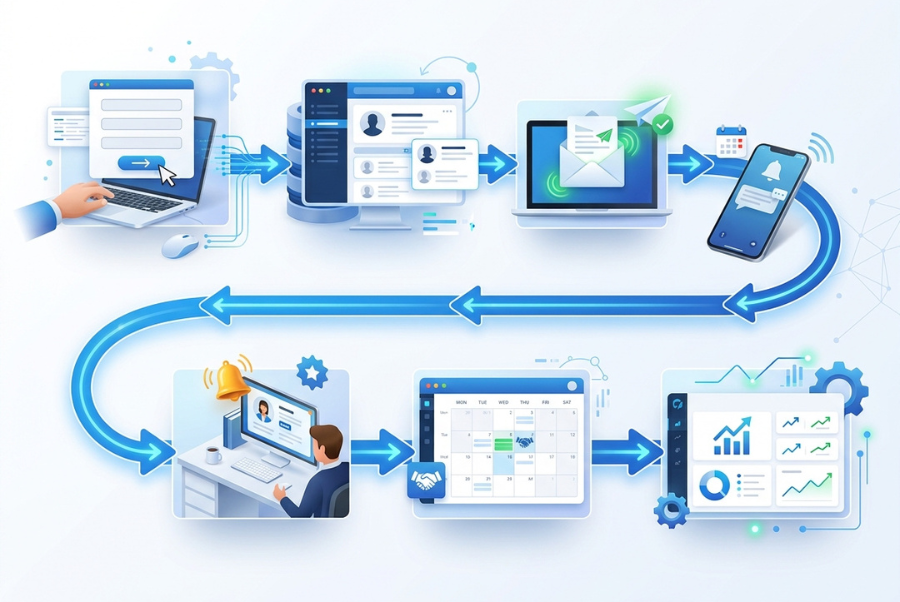
Marketing automation connects multiple marketing tools into one coordinated workflow. Customer actions trigger automated responses, allowing businesses to communicate consistently without requiring manual intervention every time.
A typical automation process follows several key stages.
Lead Capture
Every customer journey begins with collecting information from multiple sources, including:
- Website contact forms
- Google Ads
- Facebook Ads
- Landing pages
- Live chat
- Phone call tracking
- Online booking forms
Rather than storing this information in separate locations, automation consolidates everything into one centralized system.
Lead Qualification
Not every inquiry is equally valuable. Marketing automation systems can evaluate incoming leads using criteria such as:
- Location
- Service requested
- Budget
- Business size
- Customer behavior
- Pages visited
- Form responses
This process helps sales teams prioritize high-quality opportunities while continuing to nurture leads that are not yet ready to buy.
Automated Customer Communication
Once a lead enters the system, automation immediately begins communicating with the prospect.
Common automated communications include:
- Welcome emails
- Appointment confirmations
- SMS reminders
- Educational email sequences
- Promotional offers
- Review requests
- Re-engagement campaigns
Because these messages are triggered by customer behavior, communication feels timely and relevant instead of generic.
Sales Pipeline Management
Marketing automation also keeps sales pipelines organized by automatically updating lead status throughout the buying journey.
For example:
- New Lead
- Contacted
- Consultation Scheduled
- Proposal Sent
- Customer
- Repeat Customer
Whenever a customer completes one stage, the system automatically moves them to the next, ensuring that no opportunity is forgotten.
Reporting and Optimization
One of automation’s greatest strengths is its ability to measure performance continuously.
Businesses can monitor metrics such as:
- Lead volume
- Conversion rates
- Email open rates
- Cost per lead
- Appointment bookings
- Customer lifetime value
- Return on investment (ROI)
These insights make it easier to identify what’s working, eliminate bottlenecks, and improve marketing performance over time.
Together, these capabilities demonstrate how marketing automation supports every stage of the customer journey. To deliver these results effectively, most marketing automation systems rely on several core components working together.
Key Components of an Effective Marketing Automation System
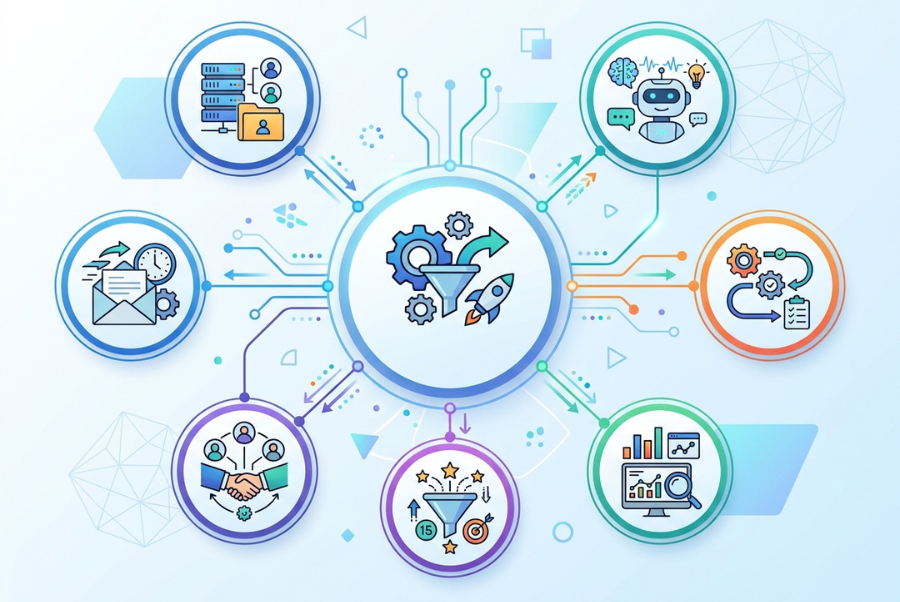
Not every automation platform offers the same capabilities. The most effective systems combine multiple tools into one connected ecosystem that supports marketing, sales, and customer service.
Customer Relationship Management (CRM)
The CRM serves as the central hub for all customer information. Every interaction—from the first inquiry to repeat purchases—is stored in one place, giving your team a complete view of each customer’s journey.
Automated Email Marketing
Email automation delivers personalized messages based on customer actions instead of sending the same message to everyone. This helps businesses nurture leads, educate prospects, and stay connected without manually creating every campaign.
Workflow Automation
Workflow automation removes repetitive tasks by creating rules that trigger specific actions. For example, when a customer submits a contact form, the system can assign the lead to a salesperson, send a confirmation email, create a follow-up task, and schedule reminder messages automatically.
Modern AI-powered automation can extend these workflows by intelligently qualifying leads, personalizing customer communications, powering conversational chatbots or AI voice agents, and identifying prospects who are most likely to convert. Unlike traditional rule-based automation, AI can adapt responses based on customer interactions, helping businesses provide faster, more relevant experiences while reducing manual decision-making.
Lead Scoring
Lead scoring assigns values to prospects based on their behaviors and likelihood of becoming customers. Businesses can focus their time on the highest-quality opportunities while continuing to nurture leads that need more information before making a purchase.
Analytics Dashboard
A centralized reporting dashboard provides real-time insights into campaign performance, customer engagement, and sales results. Instead of relying on guesswork, business owners can make informed decisions based on measurable data.
Common Marketing Processes You Can Automate
One of the biggest advantages of marketing automation is its ability to eliminate repetitive tasks while ensuring customers receive timely and consistent communication. By reducing dependence on manual processes, automation keeps marketing and sales activities running efficiently while minimizing missed opportunities.
Some of the most valuable processes businesses automate include:
- Lead capture from websites, landing pages, and online forms
- Email welcome sequences for new prospects
- Appointment scheduling and reminder notifications
- Lead assignment to the appropriate sales representative
- Customer follow-up campaigns
- Review request emails after completed services
- Abandoned inquiry follow-ups
- Newsletter distribution
- Customer re-engagement campaigns
- Reporting and marketing performance dashboards
For example, a local home service company might receive inquiries from Google Ads, Facebook Ads, and its website. Once a lead enters the system, it can be automatically categorized, assigned to the appropriate team member, sent a confirmation message, and enrolled in a scheduled follow-up sequence. This creates a smoother customer experience while reducing administrative work for staff.
As businesses continue to grow, these automated processes become increasingly valuable because they help maintain consistent service quality without requiring additional personnel for every increase in lead volume.
How Much Do Marketing Automation Systems Cost?
The cost of marketing automation varies depending on the size of your business, the complexity of your workflows, and the number of tools you want to integrate. Some businesses begin with simple automation for email marketing, while others implement advanced systems that connect CRM platforms, AI chatbots, advertising platforms, scheduling software, and analytics dashboards.
Typical monthly investment ranges include:
| Business Size | Typical Investment |
| Small business using basic automation tools | $50–$300 per month |
| Growing businesses with CRM integration | $300–$1,000+ per month |
| Custom AI automation systems with multiple integrations | $1,000–$5,000+ depending on complexity |
Several factors influence the total cost:
- Number of users
- CRM platform selection
- AI capabilities
- Third-party software integrations
- Workflow complexity
- Custom development requirements
- Training and ongoing support
While these costs may appear significant initially, they should be evaluated against the time saved, increased lead conversion rates, and reduced manual workload. Businesses often discover that automation pays for itself by improving operational efficiency and allowing employees to focus on revenue-generating activities.
Marketing Automation Options for Different Business Sizes

Not every company requires an enterprise-level automation platform. The best solution depends on your business goals, customer volume, and growth plans.
Many businesses use marketing automation platforms such as HubSpot, ActiveCampaign, GoHighLevel, or automation connectors like Zapier and Make to streamline customer communication and operational workflows. The best solution depends on your business size, existing software, automation goals, and long-term growth strategy rather than simply choosing the platform with the most features.
Small Businesses
Small businesses often benefit from straightforward automation that focuses on lead capture, email marketing, appointment reminders, and customer follow-ups. These features can significantly improve customer communication without introducing unnecessary complexity.
Growing Businesses
As lead volume increases, businesses typically expand their automation capabilities by integrating CRM systems, sales pipelines, marketing campaigns, and reporting dashboards. This provides better visibility into customer journeys while improving collaboration between marketing and sales teams.
Established Businesses
Larger organizations usually require more sophisticated automation systems capable of managing multiple marketing channels, customer segments, sales teams, and locations. Advanced AI automation can also assist with lead qualification, customer support, and predictive marketing insights.
Choosing software based solely on the number of available features isn’t always the best approach. Instead, businesses should focus on selecting a system that aligns with their current needs while allowing room for future growth.
Is Marketing Automation Worth the Investment?
For businesses experiencing steady growth, marketing automation is often one of the highest-return technology investments available. Rather than replacing employees, automation allows teams to spend less time on repetitive administrative work and more time building customer relationships and closing sales.
Some of the most common benefits include:
- Faster response times for new inquiries
- Improved lead nurturing
- Higher conversion rates
- More consistent customer communication
- Reduced manual errors
- Better reporting and decision-making
- Increased operational efficiency
- Greater scalability without proportional staffing increases
Consider two businesses receiving the same number of monthly inquiries. One relies entirely on manual follow-ups, while the other uses automation to respond immediately, schedule appointments, and continue nurturing prospects automatically. Over time, the automated business is more likely to respond faster, convert more leads, and provide a more consistent customer experience.
The return on investment isn’t measured only by additional revenue. Automation also reduces missed opportunities, improves employee productivity, and creates repeatable systems that support sustainable long-term growth.
Signs Your Business Is Ready for Marketing Automation
Many business owners wait too long before implementing automation. If your team spends more time managing processes than serving customers, it may be time to evaluate automation solutions.
Your business may be ready if you experience any of the following:
- Leads are being forgotten or contacted too late.
- Staff spend hours sending repetitive emails.
- Appointment reminders are handled manually.
- Customer information is scattered across multiple systems.
- Marketing reports require manual compilation.
- Sales follow-up is inconsistent.
- Lead volume continues to increase while efficiency declines.
These challenges often indicate that growth has outpaced existing processes. Implementing automation early can help establish scalable systems before inefficiencies become more costly.
Key Takeaways
Marketing automation systems are designed to help local businesses scale by simplifying repetitive tasks, improving lead management, and creating consistent customer experiences. Rather than replacing human interaction, automation strengthens it by ensuring timely communication and more efficient workflows.
Before investing in a platform, evaluate your current processes, identify repetitive tasks, and determine where automation can provide the greatest impact. Selecting a solution that matches your business goals today while supporting future growth will position your business for long-term success.
Frequently Asked Questions
What is a marketing automation system?
A marketing automation system is software that automates repetitive marketing and sales tasks, such as lead capture, email campaigns, follow-ups, appointment reminders, and customer segmentation. It helps businesses improve efficiency while delivering more consistent customer experiences.
How much does marketing automation cost for a local business?
Costs vary depending on the platform and level of customization. Basic solutions may start around $50 per month, while advanced systems with CRM integration, AI capabilities, and custom workflows can range from $1,000 to several thousand dollars depending on business requirements.
Can small businesses benefit from marketing automation?
Yes. Small businesses often see significant benefits because automation reduces manual work, improves response times, and ensures every lead receives consistent follow-up. Even simple workflows can save time and increase conversion rates.
What processes should businesses automate first?
Many businesses begin by automating lead capture, email follow-ups, appointment scheduling, customer reminders, review requests, and CRM updates. These processes typically deliver quick efficiency gains and improve the customer experience.
Is marketing automation worth the investment?
For businesses looking to grow, marketing automation often delivers strong long-term value by improving productivity, reducing repetitive tasks, increasing lead conversions, and supporting scalable growth without proportionally increasing staffing costs.
Conclusion
Marketing automation systems have become an essential tool for businesses that want to scale efficiently while maintaining excellent customer experiences. By automating repetitive marketing and sales processes, businesses can respond faster, nurture more leads, improve operational efficiency, and make better data-driven decisions.
Whether you’re just beginning your automation journey or looking to build a more advanced AI-powered marketing system, choosing the right strategy and implementation partner can make a significant difference in your long-term success.
If you’re ready to explore how marketing automation can support your business growth, the team at Binary Ideas Local Marketing can help design automation workflows tailored to your goals.
Binary Ideas Local Marketing
9525 4th Place
Lorton, VA 22079
Phone: (703) 690-9726
Schedule a consultation: https://binaryideas.com/contact-us/
Website: https://binaryideas.com/
Internal Links
- What Is AI Automation for Businesses and How It Drives More Leads
- What Does an AI Automation Agency Do and How It Increases ROI
- AI Automation Workflows for Local Businesses (Step-by-Step Guide)
- Service Page: AI Automation Services