

Businesses that consistently generate qualified leads rarely depend on referrals or occasional marketing campaigns. Instead, they rely on a predictable lead generation system—a structured process that continuously attracts the right audience, converts visitors into leads, nurtures prospects, and turns opportunities into paying customers. If you’re wondering how to build a predictable lead generation system, the answer lies in combining the right marketing strategies, automation, and data-driven optimization into one repeatable framework.
Rather than chasing leads every month, a well-designed system creates a reliable pipeline that helps your business forecast growth, improve marketing ROI, and scale more confidently. Whether you’re a local service business, professional practice, or growing company, investing in a lead generation system allows you to spend less time searching for customers and more time serving them.
What Is a Predictable Lead Generation System?
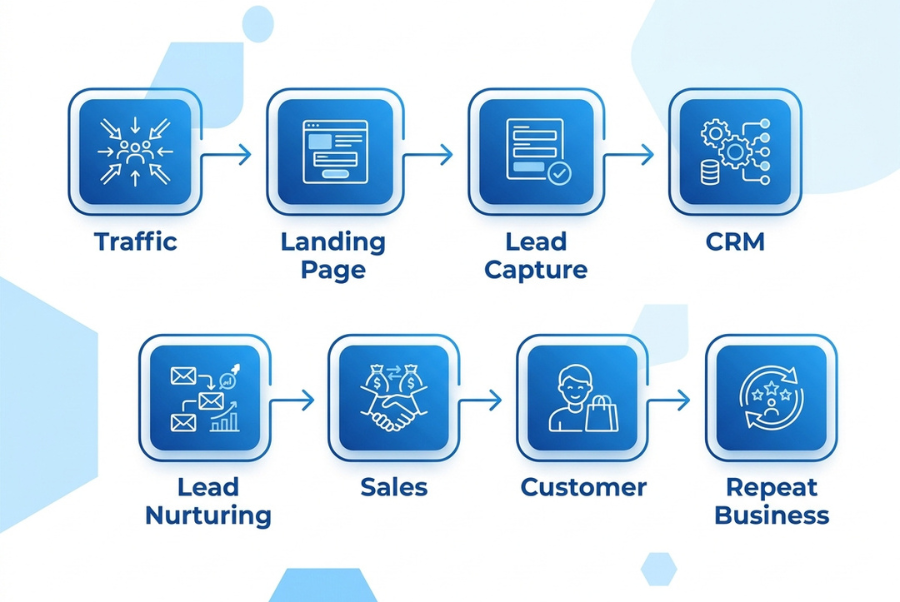
A predictable lead generation system is a repeatable marketing and sales framework that consistently attracts, captures, nurtures, and converts qualified prospects. Rather than relying on referrals, seasonal demand, or one successful marketing campaign, it creates a steady flow of opportunities through connected marketing and sales processes.
Most predictable lead generation systems include these core functions:
- Attract targeted traffic
- Convert visitors into leads
- Qualify and organize prospects
- Nurture leads through follow-up
- Track marketing performance
- Continuously optimize results
When these elements work together, businesses can generate more consistent leads, improve marketing efficiency, and support long-term growth.
Why Predictability Matters for Business Growth
A predictable system allows businesses to plan with greater confidence. Instead of wondering where the next customer will come from, you have a repeatable process for generating qualified opportunities, forecasting revenue, and making smarter marketing investments.
How It Differs from One-Off Marketing Campaigns
Individual marketing tactics such as SEO, Google Ads, or social media can generate results, but they often perform inconsistently when managed independently. For example, paid advertising may drive website traffic, but without effective landing pages, lead capture, and follow-up, many potential customers leave without taking action.
A predictable lead generation system connects every stage of the customer journey—from attracting visitors and capturing leads to nurturing prospects and measuring performance—creating a repeatable process that consistently generates qualified opportunities.
Why Most Businesses Struggle With Inconsistent Leads
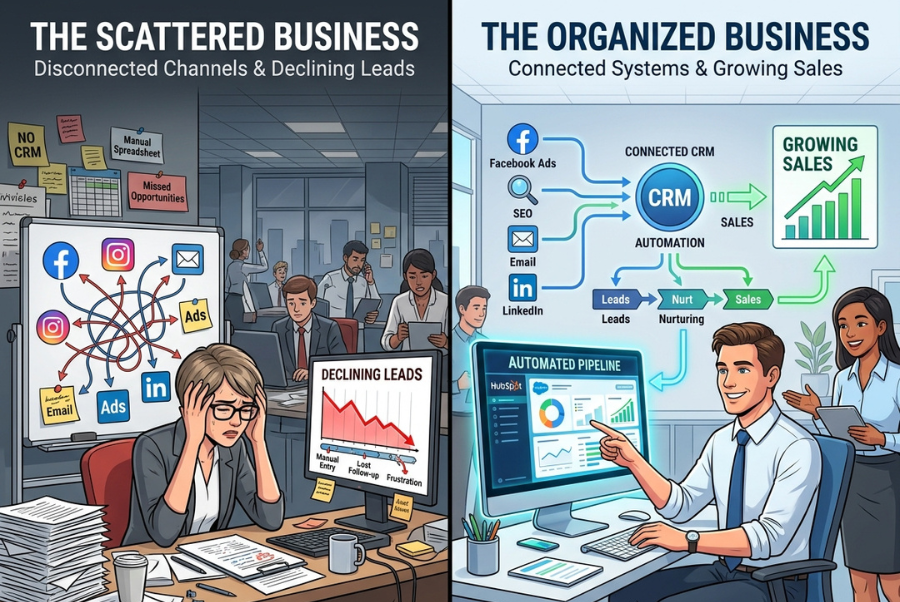
Many businesses struggle to generate consistent leads because they treat marketing as disconnected activities instead of a unified system. They may increase advertising only when sales decline, pause SEO too early, or rely heavily on referrals, making growth difficult to sustain.
Common causes include:
Lack of a Clear Marketing Strategy
Without a documented strategy, marketing becomes reactive instead of intentional. This often leads to inconsistent branding, poor audience targeting, and wasted marketing budgets. A predictable system begins with a clear understanding of your ideal customer and the channels most likely to reach them.
Weak Website Conversion Experience
Generating traffic is only the first step. If visitors don’t understand your value proposition or can’t easily take action, conversion rates suffer.
Common barriers include:
- Slow-loading pages
- Generic messaging
- Poor mobile experience
- Weak calls-to-action
- Complicated forms
- Limited trust signals
Even small improvements can have a significant impact. For example, increasing your conversion rate from 2% to 4% doubles your lead volume without increasing traffic.
No Automated Lead Nurturing
Most prospects aren’t ready to buy after their first interaction. Automated email sequences, retargeting campaigns, CRM reminders, and personalized follow-ups help keep your business top of mind while reducing manual work.
Platforms such as HubSpot provide CRM and marketing automation tools that help businesses streamline lead nurturing and follow-up throughout the customer journey.
Poor Marketing Measurement
Without tracking key performance indicators (KPIs) such as conversion rate, cost per lead (CPL), customer acquisition cost (CAC), and return on ad spend (ROAS), it’s difficult to identify bottlenecks and improve marketing performance.
Information Gain: The “Pipeline Gap” Most Businesses Miss
One overlooked challenge is the pipeline gap—the time between capturing a lead and converting them into a customer. Many businesses focus on generating traffic but lack a structured follow-up process.
For example, a contractor may respond slowly to quote requests, a law firm may not follow up with consultation inquiries, or a healthcare clinic may miss appointment reminders. Closing this gap often improves results faster than increasing advertising spend because it helps convert more of the leads you already have.
Understanding these challenges is the first step toward building a predictable lead generation system that consistently generates qualified opportunities.
How to Build a Predictable Lead Generation System

Building a predictable lead generation system requires a repeatable process that consistently attracts, converts, and nurtures qualified prospects. Follow these seven steps to create a scalable system for long-term growth.
Step 1: Define Your Ideal Customer
Identify your ideal customer by understanding their goals, challenges, buying behavior, and preferred communication channels. This helps you create targeted marketing that attracts qualified leads.
Step 2: Choose Reliable Traffic Sources
Focus on channels that consistently reach your target audience, such as SEO, Google Ads, content marketing, social media, referrals, or email marketing. Using multiple channels reduces dependence on a single lead source.
Step 3: Build High-Converting Landing Pages
Create landing pages with a clear value proposition, compelling call-to-action, and simple conversion path to encourage more visitors to become leads.
Step 4: Capture Every Lead
Use contact forms, appointment scheduling, AI chatbots, or quote request forms integrated with a CRM to ensure every inquiry is captured and managed.
Step 5: Automate Lead Nurturing
Keep prospects engaged with automated email sequences, SMS reminders, retargeting campaigns, and personalized follow-ups until they’re ready to make a decision.
Step 6: Measure Performance Using KPIs
Track metrics such as conversion rate, cost per lead (CPL), customer acquisition cost (CAC), lead-to-customer conversion rate, and return on ad spend (ROAS) to identify opportunities for improvement.
Tools such as Google Analytics can help businesses measure website traffic, user behavior, and conversion performance to identify optimization opportunities.
Step 7: Continuously Optimize Your System
Regularly review performance, test new strategies, and refine your campaigns based on data. Continuous optimization helps improve lead quality, increase conversions, and maximize marketing ROI.
Following these steps helps create a lead generation system that consistently generates qualified opportunities and supports sustainable business growth.
The 7 Essential Components of a Successful Lead Generation System
A predictable lead generation system relies on several interconnected components that work together to attract prospects, convert leads, and support long-term business growth.
1. Traffic Generation
Every lead generation system starts with attracting qualified visitors. Businesses typically combine channels such as SEO, Google Ads, content marketing, social media, and referrals to create a steady flow of potential customers.
2. High-Converting Landing Pages
Landing pages turn visitors into leads by presenting a clear value proposition, building trust, and encouraging prospects to take the next step.
3. Lead Capture
Lead capture tools—such as contact forms, appointment scheduling, AI chatbots, and downloadable resources—ensure every opportunity enters your sales pipeline.
4. Lead Nurturing
Most prospects aren’t ready to buy immediately. Email campaigns, educational content, retargeting ads, and personalized follow-ups help build trust and keep your business top of mind.
5. CRM and Sales Pipeline Management
A CRM organizes customer information, tracks interactions, and helps sales teams manage opportunities more efficiently while reducing missed follow-ups.
6. Analytics and Performance Measurement
Monitoring metrics such as conversion rate, cost per lead (CPL), customer acquisition cost (CAC), and return on ad spend (ROAS) helps identify opportunities to improve marketing performance.
7. Continuous Optimization
Regularly reviewing campaign performance, testing new ideas, and refining your strategy helps improve lead quality, increase conversions, and maximize long-term marketing ROI.
Together, these components create a connected lead generation system that consistently generates qualified opportunities and supports sustainable business growth.
How AI Improves Every Stage of Your Lead Generation System
Artificial intelligence (AI) enhances lead generation by automating repetitive tasks, improving response times, and delivering more personalized customer experiences. Rather than replacing human interaction, AI helps businesses streamline routine processes so marketing and sales teams can focus on building relationships and closing more qualified opportunities.
AI supports every stage of a predictable lead generation system—from attracting visitors to optimizing performance.
AI Applications Across the Lead Generation Process
AI can improve efficiency throughout the customer journey by supporting key stages of the lead generation process:
| Lead Generation Stage | How AI Helps |
| Traffic Generation | Optimizes audience targeting, advertising campaigns, and content recommendations to attract qualified visitors. |
| Lead Capture | AI chatbots and intelligent forms engage visitors, answer common questions, and collect contact information 24/7. |
| Lead Qualification | Lead scoring identifies high-intent prospects based on behavior, demographics, and engagement. |
| Lead Nurturing | Personalized email campaigns, SMS reminders, and automated follow-ups keep prospects engaged throughout the buying journey. |
| Sales Process | Appointment scheduling, CRM automation, and task reminders help sales teams respond more efficiently. |
| Performance Optimization | Predictive analytics and reporting identify trends, measure campaign performance, and highlight opportunities for improvement. |
When integrated into a lead generation system, these capabilities reduce manual work, improve response times, and create a more consistent customer experience.
Information Gain: AI Should Support—Not Replace—Human Relationships
One common misconception is that AI replaces human interaction. In reality, AI is most effective when it automates repetitive tasks, allowing teams to focus on conversations that require expertise and relationship building.
For example, AI can respond to after-hours inquiries, collect contact information, schedule consultations, and notify the sales team, allowing them to begin informed conversations the next business day.
To learn more about implementing automation across your marketing and sales processes, explore our guides on What Is AI Automation for Businesses and How It Drives More Leads ,AI Automation Workflows for Local Businesses and How to Reduce Cost Per Lead Using AI and Optimization Strategies. If you’re ready to build a scalable lead generation system, explore our AI Automation services to see how CRM integration, intelligent workflows, and AI-powered automation can help your business generate, nurture, and convert more qualified leads.
How Much Does It Cost to Build a Lead Generation System?
The cost of building a lead generation system depends on your business goals, marketing channels, and the level of automation you need. Some businesses start with a basic setup using affordable software, while others invest in fully integrated solutions that combine CRM platforms, AI automation, SEO, paid advertising, and analytics.
Typical Costs
Most lead generation systems include tools such as:
- CRM software
- Marketing automation platforms
- Landing page builders
- Email marketing software
- AI chatbots
- Analytics and reporting tools
Software costs can range from a few hundred dollars per month for a basic setup to several thousand dollars for enterprise-level solutions.
What Affects the Investment?
In addition to software, businesses should consider expenses such as SEO, paid advertising, landing page development, CRM integration, AI workflow automation, and ongoing campaign optimization. Total investment varies depending on whether you build and manage the system yourself or work with marketing or AI automation professionals.
Cost vs. Long-Term Value
Rather than focusing only on upfront costs, evaluate the long-term return. A well-designed lead generation system can improve conversion rates, lower cost per lead (CPL), increase marketing efficiency, and generate a more predictable flow of qualified opportunities over time.
Lead Generation System Options
There is no one-size-fits-all approach to building a lead generation system. The best option depends on your budget, available resources, technical expertise, and long-term growth goals.
| Option | Best For | Advantages | Considerations |
| DIY | Startups and small businesses | Lowest upfront cost, full control | Requires time to learn, manage, and optimize marketing tools |
| Freelancers | Businesses needing specialized skills | Cost-effective for SEO, design, advertising, or content | Coordinating multiple freelancers can be challenging |
| Marketing Agency | Growing businesses | Comprehensive marketing strategy managed by experienced specialists | Typically requires a larger investment than DIY or freelancers |
| AI Automation Agency | Businesses focused on scaling | Combines digital marketing, CRM integration, workflow automation, AI-powered follow-up, and performance optimization | Best suited for businesses seeking long-term efficiency and scalable growth |
Which Option Is Right for Your Business?
Choose the solution that best matches your current business stage and available resources. DIY works well for businesses just getting started, while freelancers are ideal for filling specific skill gaps. Businesses looking for consistent growth often benefit from a marketing agency, whereas companies seeking to automate processes, improve efficiency, and scale lead generation may find an AI automation agency to be the most comprehensive solution.
Before making a decision, evaluate not only the upfront investment but also the time, expertise, and ongoing management required to achieve consistent results.
Common Mistakes That Prevent Predictable Lead Generation
Even with the right tools and marketing channels, avoidable mistakes can prevent a lead generation system from delivering consistent results. Recognizing these common issues helps improve performance and long-term growth.
Relying on a Single Traffic Source
Depending on only one channel—such as referrals, Google Ads, or social media—increases risk. Diversifying your traffic sources creates a more stable flow of qualified leads.
Neglecting Lead Follow-Up
Many prospects require multiple touchpoints before making a decision. Consistent follow-up through email, CRM reminders, and marketing automation helps keep your business top of mind and improves conversion rates.
Poor Landing Page Experience
Weak messaging, confusing layouts, or complicated forms can reduce conversions. Every landing page should clearly communicate your value proposition and make it easy for visitors to take the next step.
Not Tracking Performance
Without monitoring key metrics such as conversion rate, cost per lead (CPL), customer acquisition cost (CAC), and return on ad spend (ROAS), it’s difficult to identify opportunities for improvement and optimize marketing performance.
Giving Up Too Soon
Building a predictable lead generation system takes time. Businesses that consistently measure, refine, and optimize their marketing efforts are more likely to achieve sustainable long-term growth than those that frequently change strategies or stop too early.
Is Building a Predictable Lead Generation System Worth It?
For businesses focused on long-term growth, the answer is typically yes. A predictable lead generation system replaces inconsistent marketing with a repeatable process for attracting, nurturing, and converting qualified prospects while providing the data needed to make smarter marketing decisions.
Key Benefits
A well-designed lead generation system can help businesses:
- Generate a more consistent flow of qualified leads
- Improve marketing efficiency and ROI
- Respond to prospects faster through automation
- Gain better visibility into marketing and sales performance
- Build a scalable foundation for long-term growth
Who Benefits Most?
A predictable lead generation system is valuable for any business that depends on acquiring new customers, particularly local service businesses, professional service providers, contractors, healthcare practices, and growing companies looking to scale beyond referrals.
Ultimately, the greatest value isn’t simply generating more leads—it’s creating a reliable system that consistently produces qualified opportunities and supports sustainable business growth.
Key Takeaways
If you’re learning how to build a predictable lead generation system, remember these core principles:
- Build a complete system rather than relying on individual marketing tactics.
- Combine SEO, paid advertising, automation, and conversion optimization.
- Track key performance indicators (KPIs) and continuously optimize your results.
- Use AI to improve efficiency while maintaining meaningful human interactions.
Businesses that invest in a repeatable lead generation system are better positioned to scale consistently and improve long-term marketing performance.
Frequently Asked Questions
How long does it take to build a predictable lead generation system?
Most businesses can establish the foundation of a lead generation system within a few weeks. However, achieving consistent results requires ongoing optimization as you collect data, refine campaigns, and improve conversion rates over time.
How much does it cost to build a lead generation system?
The cost varies depending on your business goals, marketing channels, and level of automation. A basic system may require only a few software tools, while more advanced solutions often include CRM integration, AI automation, paid advertising, and ongoing optimization.
Can small businesses benefit from a lead generation system?
Yes. Even a simple system that combines a professional website, CRM, email follow-up, and basic SEO can help small businesses generate more consistent leads without significantly increasing marketing costs.
Is SEO or Google Ads better for lead generation?
Both can be effective, but they serve different purposes. SEO helps generate sustainable long-term traffic, while Google Ads can produce qualified leads more quickly. Many businesses achieve the best results by combining both strategies within a single lead generation system.
What is the most important part of a lead generation system?
Every component plays an important role, but consistent lead follow-up is often the biggest factor influencing conversions. Prompt responses, personalized communication, and automated nurturing help ensure qualified prospects continue moving through the buying journey rather than choosing a competitor.
Conclusion
Building a predictable lead generation system isn’t about relying on a single marketing tactic—it’s about creating a repeatable process that consistently attracts, nurtures, and converts qualified leads. By combining proven marketing strategies, automation, and continuous optimization, businesses can create a more reliable pipeline and support sustainable long-term growth.
Ready to Build a Predictable Lead Generation System?
If you’re ready to build a scalable lead generation system that combines AI automation, Local SEO, paid advertising, CRM integration, and conversion optimization, Binary Ideas Local Marketing can help. Our team works with businesses to develop data-driven marketing systems that generate qualified leads and support long-term growth.
Schedule a Free Consultation: https://binaryideas.com/contact-us/
Binary Ideas Local Marketing
Address
9525 4th Place
Lorton, VA 22079
Phone
(703) 690-9726
Website
https://binaryideas.com