
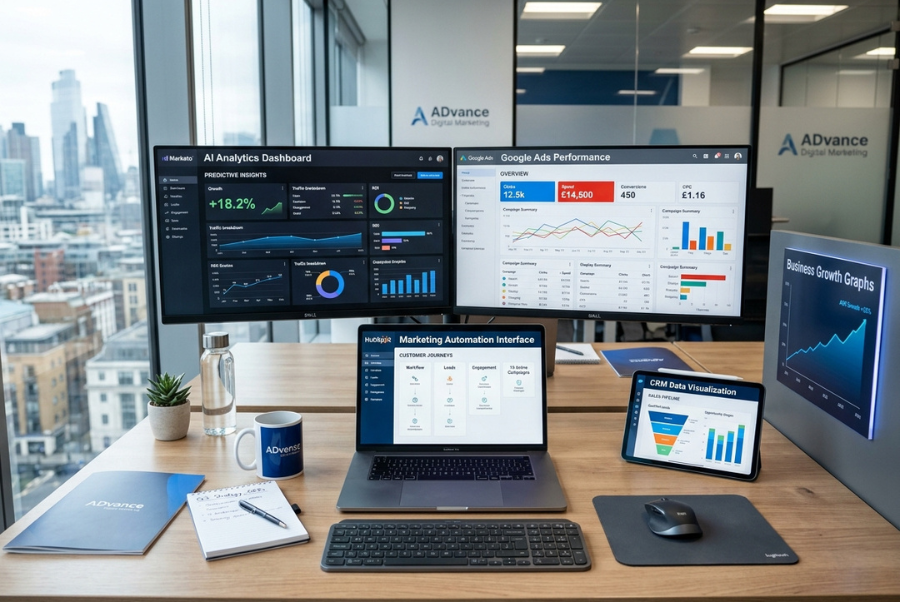
Generating more leads doesn’t always mean better business results—especially if each lead costs too much to acquire. How to reduce cost per lead using AI starts with smarter audience targeting, automation, and continuous optimization that improve marketing efficiency while maximizing return on investment (ROI).
Whether you rely on Google Ads, Facebook Ads, SEO, or multiple marketing channels, lowering your cost per lead (CPL) requires optimizing your entire lead generation process. From attracting qualified visitors to automating follow-ups and improving landing page performance, AI helps businesses make faster, data-driven decisions that reduce wasted ad spend and increase conversions.
Reduce Your Cost Per Lead With Smarter AI Marketing
If your business is generating leads but spending too much to acquire each customer, an AI-driven marketing strategy can improve campaign performance while lowering acquisition costs. At Binary Ideas Local Marketing, we combine AI automation, Google Ads, Local SEO, and conversion optimization to help businesses generate more qualified leads at a lower cost.
Binary Ideas Local Marketing
9525 4th Place, Lorton, VA 22079
Phone: (703) 690-9726
Schedule a consultation with Binary Ideas Local Marketing to discover how AI-powered lead generation can help your Northern Virginia business reduce cost per lead and improve marketing ROI.
What Is Cost Per Lead (CPL)?

Cost per lead (CPL) measures how much your business spends to generate one potential customer. It helps evaluate marketing efficiency by comparing total marketing spend against the number of qualified leads generated.
The basic formula is simple:
Cost Per Lead = Total Marketing Spend ÷ Number of Leads Generated
For example, if you spend $2,000 on advertising and generate 100 qualified leads, your cost per lead is $20.
While a lower CPL is desirable, lead quality matters more than quantity. Cheap leads that rarely convert into paying customers often cost more in the long run than fewer, highly qualified prospects.
To evaluate marketing performance more accurately, businesses should also monitor:
- Lead-to-customer conversion rate
- Customer acquisition cost (CAC)
- Customer lifetime value (CLV)
- Return on advertising spend (ROAS)
- Overall marketing ROI
Reviewing these metrics together provides a clearer picture of campaign profitability and long-term growth.
How Cost Per Lead Is Calculated
Every marketing campaign includes expenses that contribute to your overall CPL, such as:
- Google Ads campaigns
- Facebook and Instagram advertising
- SEO investments
- AI automation software
- Marketing agency fees
- Landing page development
- CRM and marketing automation tools
- Content creation
After totaling your marketing expenses for a specific period, divide that amount by the number of qualified leads generated.
| Total Marketing Spend | Leads Generated | Cost Per Lead |
| $1,500 | 75 | $20 |
| $5,000 | 200 | $25 |
| $10,000 | 600 | $16.67 |
Tracking CPL over time helps businesses identify trends, compare marketing channels, and optimize marketing budgets.
Example: Two companies each spend $3,000 on advertising. Company A generates 60 qualified leads ($50 CPL), while Company B generates 120 qualified leads ($25 CPL). Although both spend the same amount, Company B’s optimized funnel delivers twice as many qualified opportunities.
Why Cost Per Lead Matters More Than Click Costs
Many businesses focus on lowering cost per click (CPC), but clicks alone don’t generate revenue. A campaign with higher CPC can still produce a lower CPL if it attracts qualified prospects who are more likely to convert.
Rather than optimizing for traffic volume, businesses should focus on lead quality and conversion efficiency. AI supports this approach by identifying high-intent audiences and continuously refining campaign performance to maximize marketing ROI.
Common Reasons Businesses Have High Cost Per Leads
High CPL is usually caused by multiple inefficiencies across the lead generation funnel rather than a single issue. Common causes include:
- Targeting audiences that are too broad or poorly defined
- Sending paid traffic to low-converting landing pages
- Slow website performance
- Weak calls to action
- Delayed lead follow-up
- Poor conversion tracking
- Manual campaign management
Improving landing pages, lead qualification, follow-up processes, and conversion tracking often reduces CPL more effectively than simply increasing advertising budgets.
Understanding what influences cost per lead is the first step. Next, let’s explore how AI helps businesses optimize campaigns, improve conversions, and lower acquisition costs.
How AI Helps Reduce Cost Per Lead

Artificial intelligence transforms digital marketing by continuously analyzing campaign data, identifying optimization opportunities, and automating repetitive tasks. Rather than replacing marketers, AI improves decision-making, campaign efficiency, and overall lead generation performance.
For businesses focused on lowering CPL, AI enhances nearly every stage of the customer journey—from audience targeting and advertising to lead qualification and follow-up.
AI Improves Audience Targeting
One of the biggest contributors to high CPL is showing advertisements to people who have little interest in your products or services.
AI analyzes behavioral, demographic, geographic, and intent-based data to identify audiences that closely resemble your highest-value customers. As new data becomes available, machine learning algorithms continuously refine targeting, allowing campaigns to improve without constant manual adjustments.
Instead of guessing who may be interested, businesses can focus their advertising budgets on prospects with a higher likelihood of becoming qualified leads. For local service businesses, this means reaching homeowners, business owners, or decision-makers actively searching for solutions, improving lead quality while reducing wasted advertising spend.
AI Optimizes Ad Campaigns Automatically
Modern advertising platforms use AI to optimize campaigns in real time.
Machine learning can automatically adjust:
- Bid strategies
- Budget allocation
- Audience segments
- Ad placements
- Device targeting
- Time-of-day scheduling
These real-time adjustments help shift marketing budgets toward higher-performing opportunities. For example, AI can prioritize keywords that consistently generate lower-cost, higher-quality leads while reducing spend on underperforming search terms.
AI Scores and Qualifies Leads
Not every lead has the same value.
AI-powered lead scoring evaluates prospects using signals such as:
- Website pages visited
- Time spent on site
- Form submissions
- Previous interactions
- Geographic location
- Purchase intent
- Engagement history
Sales teams can prioritize the most qualified opportunities instead of treating every inquiry equally. This improves efficiency while reducing the time and cost spent pursuing low-quality leads.
AI Automates Lead Follow-Up
Fast responses often lead to higher conversion rates.
AI automation helps businesses engage new inquiries immediately by:
- Sending personalized email responses
- Initiating SMS follow-ups
- Scheduling appointments
- Answering common questions through AI chatbots
- Routing qualified leads to the appropriate sales representative
- Triggering automated nurture campaigns
These automated workflows ensure every qualified lead receives timely engagement. Faster follow-up improves conversion rates, helping businesses acquire more customers without increasing advertising budgets.
Optimization Strategies That Lower Cost Per Lead

AI identifies optimization opportunities, but reducing cost per lead requires continuously improving every stage of the marketing funnel—from attracting qualified visitors to converting them into customers.
Improve Landing Page Conversion Rates
Even the best advertising campaign will underperform if the landing page fails to convert visitors. Optimized landing pages increase conversions without increasing advertising spend.
Effective landing pages typically include:
- A clear value proposition above the fold
- A compelling headline focused on customer benefits
- Simple, easy-to-complete contact forms
- Strong calls to action (CTAs)
- Trust signals such as reviews, testimonials, certifications, or case studies
- Mobile-friendly, responsive design
- Fast page loading speeds
AI tools further improve landing page performance by analyzing heatmaps, click tracking, and session recordings to identify where visitors hesitate or abandon the page.
Optimize Google Ads Campaign Structure
Well-structured Google Ads campaigns improve Quality Score by matching keywords, ad groups, and landing pages to user intent. AI further enhances performance through automated bidding and continuous optimization.
Optimization strategies include:
- Organizing campaigns by service or product category
- Using tightly themed keyword groups
- Writing highly relevant ad copy
- Adding negative keywords to eliminate irrelevant searches
- Monitoring search term reports regularly
- Using AI-powered Smart Bidding strategies
AI continuously evaluates signals such as device type, location, search intent, and historical performance to allocate budgets toward higher-performing opportunities.
Refine Facebook Ads Targeting
Broad audience targeting often increases advertising costs without improving lead quality. AI helps identify users most likely to convert by analyzing demographics, interests, behaviors, and engagement history.
Optimization techniques include:
- Building lookalike audiences from existing customers
- Creating segmented campaigns
- Excluding converted audiences
- Testing multiple creative variations
- Optimizing campaigns for qualified leads instead of clicks
As campaigns collect more data, AI continually improves audience selection, reducing wasted impressions and lowering overall CPL.
Improve Website Speed and User Experience
Website speed and user experience directly influence conversion rates. Faster-loading pages, mobile responsiveness, and simple navigation encourage more visitors to become qualified leads.
Focus on improving:
- Page loading speed
- Mobile responsiveness
- Clear navigation
- Simple contact forms
- Easy-to-read content
- Accessible design
AI-powered website analytics help identify technical issues that negatively impact conversions, allowing businesses to prioritize high-impact improvements.
Use Retargeting to Recover Lost Leads
Most visitors don’t convert during their first visit. Retargeting reconnects with interested prospects through Google Display Ads, Facebook Ads, Instagram Ads, and other platforms, increasing conversion opportunities without significantly increasing acquisition costs.
Common retargeting audiences include:
- Visitors who viewed service pages
- Users who abandoned contact forms
- Previous quote requests
- Returning website visitors
- Existing email subscribers
AI identifies the audiences most likely to return and automatically optimizes bids and messaging for better results.
Continuously A/B Test Ads and Landing Pages
A/B testing compares different versions of advertisements and landing pages to identify which combinations generate more qualified leads. AI accelerates this process by automatically directing more traffic to higher-performing variations.
Common elements to test include:
- Headlines
- CTA buttons
- Images
- Form length
- Page layouts
- Ad copy
- Promotional offers
Expert Insight: Many businesses try to lower CPL by reducing advertising budgets. In reality, improving landing page conversion rates—for example, from 5% to 8%—can significantly reduce cost per lead without increasing ad spend.
How Much Does It Cost to Implement AI Lead Optimization?
The cost of AI lead optimization depends on your business size, marketing goals, advertising budget, and whether you manage campaigns internally or work with a marketing agency. While there is an upfront investment, many businesses recover these costs through improved conversion rates, lower acquisition costs, and greater marketing efficiency.
DIY AI Tools
Businesses with in-house marketing teams can implement AI tools independently.
| AI Solution | Estimated Monthly Cost |
| AI writing and content tools | $20–$100 |
| AI chatbots | $50–$500 |
| CRM automation | $30–$300+ |
| Marketing automation software | $100–$1,000+ |
| Analytics and optimization platforms | $50–$500+ |
DIY solutions typically require ongoing management, technical expertise, and continuous optimization.
Hiring an AI Marketing Agency
An experienced AI marketing agency provides strategy, implementation, optimization, reporting, and ongoing campaign management.
| Service Level | Estimated Monthly Investment |
| Small local business | $1,000–$3,000 |
| Growing businesses | $3,000–$7,500 |
| Multi-location or competitive industries | $7,500–$20,000+ |
Pricing varies based on campaign complexity, advertising budgets, automation requirements, and the number of marketing channels being managed.
Factors That Affect Pricing
Several factors influence implementation costs, including:
- Industry competitiveness
- Advertising budget
- Geographic targeting
- Number of campaigns
- AI automation complexity
- CRM integration requirements
- Landing page development
- Conversion tracking implementation
- Reporting and analytics
Highly competitive industries generally require larger investments because of increased advertising competition and customer acquisition costs.
Expected Return on Investment
Businesses often see improvements in:
- Lower cost per lead
- Higher lead quality
- Increased conversion rates
- Faster response times
- Reduced manual workload
- Better advertising efficiency
- Improved marketing ROI
Rather than viewing AI as an additional expense, businesses should see it as an investment in operational efficiency and long-term growth.
Practical Example: Two businesses each spend $5,000 per month on advertising. Business A generates 100 leads ($50 CPL), while Business B uses AI optimization to generate 160 leads ($31.25 CPL)—a 37.5% reduction without increasing ad spend.
AI Tools That Help Reduce Cost Per Lead
AI-powered marketing tools help automate repetitive tasks, improve decision-making, and optimize marketing performance. The right combination depends on your goals, budget, and existing technology stack.
AI-Powered Advertising Platforms
AI-powered advertising platforms automate:
- Smart bidding
- Audience targeting
- Budget allocation
- Keyword optimization
- Performance forecasting
- Campaign recommendations
These capabilities reduce wasted advertising spend while improving lead quality.
CRM Automation
AI-powered CRM systems help sales teams prioritize high-value opportunities through:
- Lead scoring
- Pipeline forecasting
- Automated follow-up reminders
- Customer segmentation
- Sales opportunity prioritization
- Workflow automation
This allows sales teams to spend more time selling and less time on administrative tasks.
AI Chatbots
AI chatbots engage visitors instantly by:
- Answering common questions
- Collecting lead information
- Qualifying prospects
- Scheduling appointments
- Routing inquiries
- Triggering automated nurture campaigns
Immediate responses help businesses engage prospects faster, increasing the likelihood of converting qualified leads.
Predictive Analytics
Predictive analytics helps businesses:
- Identify high-converting audiences
- Forecast campaign performance
- Estimate lead quality
- Predict customer lifetime value
- Allocate marketing budgets more effectively
Instead of reacting to poor performance, businesses can make proactive, data-driven decisions.
Marketing Automation Platforms
Marketing automation platforms connect multiple marketing activities into one workflow, including:
- Email campaigns
- SMS follow-ups
- Lead nurturing
- Appointment reminders
- Customer segmentation
- Workflow automation
- Performance reporting
When combined with AI, these platforms personalize communications, prioritize high-intent leads, and improve customer engagement.
Understanding these optimization strategies is only part of the equation. Next, we’ll look at the common mistakes that increase cost per lead, compare AI with traditional optimization methods, and determine whether AI is the right investment for your business.
Common Mistakes That Increase Cost Per Lead
High cost per lead (CPL) is rarely caused by expensive advertising alone. More often, it results from inefficiencies throughout the marketing funnel that reduce conversions and waste advertising spend. Identifying these issues allows businesses to improve marketing efficiency and maximize return on investment (ROI).
Sending Traffic to Weak Landing Pages
Driving qualified traffic is only half the battle. If visitors arrive on a slow, confusing, or poorly designed landing page, they’re unlikely to convert regardless of how effective the advertisement is.
Common landing page issues include:
- Generic headlines that fail to communicate value
- Too much information above the fold
- Weak or unclear calls to action
- Long, complicated forms
- Slow loading times
- Poor mobile experience
- Missing trust signals such as reviews or testimonials
AI-powered analytics, including heatmaps and session recordings, help identify where visitors hesitate or abandon the page, allowing businesses to make data-driven improvements.
Targeting the Wrong Audience
Showing advertisements to people with little purchase intent is one of the fastest ways to increase CPL.
Businesses should continually refine targeting based on:
- Customer demographics
- Geographic location
- Search intent
- Interests and behaviors
- Previous website interactions
- Buying stage
AI continuously evaluates audience performance and reallocates budgets toward higher-converting customer segments, improving lead quality while reducing wasted advertising spend.
Ignoring Existing Leads
Many businesses focus on generating new leads while overlooking prospects already in their CRM.
These contacts may have:
- Requested quotes
- Downloaded resources
- Visited pricing pages
- Scheduled consultations
- Started—but not completed—contact forms
Because these prospects have already shown interest, AI-powered email automation, SMS reminders, and remarketing campaigns can often convert them at a lower cost than acquiring entirely new leads.
Failing to Track Conversions Properly
Accurate conversion tracking is essential for campaign optimization.
Businesses should monitor:
- Form submissions
- Phone calls
- Appointment bookings
- Live chat conversations
- Online purchases
- Offline conversions
- Revenue generated
Without reliable tracking, AI has limited data for optimization, making it difficult to improve campaign performance or reduce CPL.
Optimizing Only for Clicks Instead of Revenue
Clicks don’t automatically generate customers.
Successful businesses measure marketing performance using metrics such as:
- Qualified leads
- Sales opportunities
- Customer acquisition cost
- Customer lifetime value
- Revenue generated
- Return on marketing investment
AI helps optimize campaigns around business outcomes rather than vanity metrics, allowing marketing budgets to focus on strategies that generate profitable customers.
Expert Insight: AI shifts marketing from campaign optimization to business optimization. Instead of asking, “Which ad gets the most clicks?” businesses begin asking, “Which marketing activities consistently generate profitable customers?”
AI vs Traditional Lead Generation Optimization
Traditional marketing relies on manual analysis and periodic campaign adjustments. AI complements human expertise by analyzing large amounts of data in real time and continuously optimizing campaign performance.
| Feature | AI-Powered Optimization | Traditional Optimization |
| Campaign adjustments | Continuous, real-time optimization | Manual reviews and periodic updates |
| Audience targeting | Predictive and behavior-based | Broad demographic targeting |
| Bid management | Automated machine learning | Manual bid adjustments |
| Data analysis | Millions of data points simultaneously | Limited manual analysis |
| Lead qualification | AI lead scoring | Manual review process |
| Follow-up | Automated workflows and personalization | Manual emails and phone calls |
| Scalability | Easily expands across campaigns | Requires additional staff and time |
| Learning speed | Continuously improves with new data | Improvements depend on manual testing |
Why AI Delivers Better Results
AI improves marketing by:
- Optimizing campaigns continuously
- Analyzing customer behavior in real time
- Identifying high-performing audiences
- Allocating budgets more efficiently
- Learning from every campaign
Rather than replacing marketers, AI enables faster, data-driven decisions that improve long-term marketing performance.
Is AI Worth It for Reducing Cost Per Lead?
For many businesses, the answer is yes. When combined with accurate data, clear marketing goals, and continuous optimization, AI helps lower acquisition costs while improving lead quality and marketing efficiency.
Businesses That Benefit the Most
AI often delivers the strongest ROI for businesses that:
- Generate leads online consistently
- Invest in Google Ads or Facebook Ads
- Operate in competitive industries
- Receive a high volume of inquiries
- Have established sales processes
- Want to scale without significantly increasing staffing
Common examples include:
- Home service companies
- Healthcare providers
- Law firms
- Real estate agencies
- Marketing agencies
- Contractors
- Financial service providers
When AI May Not Be Necessary
Businesses may benefit less from AI if they:
- Receive very few leads
- Lack accurate conversion tracking
- Have no defined marketing strategy
- Operate outdated websites with poor conversion rates
- Rarely review campaign performance
Strengthening these fundamentals first often produces better long-term results before implementing AI automation.
Expected ROI Timeline
Although results vary, many businesses begin seeing measurable improvements after AI gathers enough campaign data for optimization.
| Timeline | Expected Improvements |
| First 30 days | Tracking validation and baseline data collection |
| 30–90 days | Better targeting, improved lead quality, lower CPL |
| 3–6 months | Higher conversion rates and increasing ROI |
| 6–12 months | Mature automation and scalable lead generation |
Businesses that continuously test, measure, and refine their marketing strategies typically achieve stronger long-term results than those relying on quick fixes.
Long-Term Competitive Advantages
Businesses that successfully implement AI often gain advantages such as:
- Faster campaign optimization
- Better customer experiences
- More accurate forecasting
- Higher-quality leads
- Greater operational efficiency
- More scalable marketing systems
- Stronger return on investment
Rather than relying on intuition alone, businesses can make better marketing decisions using continuously improving data insights.
Key Takeaways
- Lowering cost per lead requires optimizing the entire customer journey—not just reducing advertising spend.
- High-converting landing pages, accurate targeting, and fast follow-up often have a greater impact than increasing ad budgets.
- AI improves marketing through automation, predictive analytics, and real-time optimization.
- Success should be measured by qualified leads, revenue, and ROI—not clicks or impressions.
- Continuous testing and data-driven optimization create sustainable long-term marketing growth.
What to Expect When Working With an AI Marketing Agency
Partnering with an AI marketing agency is about more than adopting new technology. The right agency combines AI-powered tools with proven marketing strategies to improve campaign performance, lower cost per lead, and build a scalable lead generation system tailored to your business.
Initial Marketing Audit
A successful AI strategy begins with a review of your current marketing performance, including:
- Google Ads and Facebook Ads performance
- Website conversion rates
- Landing page effectiveness
- SEO visibility
- Lead generation funnel
- CRM and marketing automation
- Conversion tracking
- Customer acquisition costs
This audit identifies where leads are being lost and which improvements will have the greatest impact on reducing CPL.
Campaign Optimization Strategy
Based on the audit, the agency develops a customized plan that may include:
- Refining audience targeting
- Improving campaign structure
- Optimizing landing pages
- Enhancing conversion tracking
- Implementing AI-powered bidding
- Building remarketing campaigns
- Improving lead qualification
The objective is to optimize the entire customer journey rather than individual marketing channels.
AI Automation Setup
AI automation helps businesses respond faster while reducing repetitive manual work.
Typical implementations include:
- Instant lead notifications
- AI chatbots
- Automated email campaigns
- SMS follow-ups
- Appointment scheduling
- CRM workflow automation
- Lead scoring
- Customer segmentation
Reporting and Continuous Improvement
AI optimization is an ongoing process.
A quality agency continually reviews performance using metrics such as:
- Cost per lead (CPL)
- Conversion rate
- Lead quality
- Return on ad spend (ROAS)
- Marketing ROI
- Campaign trends
Regular reporting helps identify new optimization opportunities and supports continuous improvement.
How to Choose an AI Marketing Agency
Choosing the right agency means evaluating experience, transparency, and measurable business results—not marketing promises.
Questions to Ask
Before hiring an agency, ask:
- How do you use AI in marketing campaigns?
- Which industries have you worked with?
- How do you measure success?
- What reporting will I receive?
- Who owns the advertising accounts and campaign data?
- How do you improve conversion rates?
- Can you integrate AI with our CRM?
Clear, transparent answers usually indicate a structured, results-driven process.
Red Flags
Be cautious of agencies that:
- Guarantee first-page rankings
- Promise instant results
- Focus only on traffic instead of qualified leads
- Avoid discussing analytics or conversion tracking
- Lock clients into long-term contracts without performance reviews
- Provide vague reporting
Successful marketing relies on continuous testing, optimization, and measurable performance.
Key Features to Look For
A strong AI marketing agency should provide:
- AI-powered campaign optimization
- Google Ads and Facebook Ads management
- Local SEO
- Conversion rate optimization (CRO)
- Marketing automation
- CRM integration
- Transparent reporting
- Ongoing optimization and strategic guidance
Above all, they should focus on generating profitable customers—not simply increasing website traffic.
Frequently Asked Questions
How can AI reduce cost per lead?
AI lowers cost per lead by improving audience targeting, automating campaign optimization, qualifying leads, and increasing conversion rates, helping businesses generate more qualified prospects with less wasted advertising spend.
What is considered a good cost per lead?
A good CPL depends on your industry, competition, and customer lifetime value. The ideal cost is one that allows your business to acquire customers profitably while maintaining a positive ROI.
How long does it take to lower cost per lead with AI?
Some improvements appear within the first few weeks, but meaningful optimization usually takes several months as AI gathers data and continuously refines campaigns.
Can small businesses benefit from AI marketing?
Yes. AI helps small businesses automate repetitive tasks, improve campaign performance, respond to leads faster, and compete more efficiently without significantly increasing staffing.
Which marketing channels benefit the most from AI optimization?
AI improves Google Ads, Facebook Ads, SEO, email marketing, CRM automation, landing page optimization, and lead nurturing. The greatest results typically come from integrating these channels into one coordinated strategy.
Conclusion
Reducing cost per lead isn’t about spending less—it’s about making every marketing dollar work harder. Businesses that combine AI automation with continuous optimization can improve audience targeting, increase conversions, automate lead management, and generate higher-quality leads without proportionally increasing advertising budgets.
If you’re looking to reduce your cost per lead while improving marketing performance, Binary Ideas Local Marketing can help you build an AI-powered strategy tailored to your business goals.
Binary Ideas Local Marketing
9525 4th Place, Lorton, VA 22079
Phone: (703) 690-9726
Website: https://binaryideas.com/
Contact Us: https://binaryideas.com/contact-us/
Ready to improve your marketing ROI? Contact our team today to learn how AI automation, Local SEO, and paid advertising can help your business generate more qualified leads at a lower cost.
Related Reading
- What Is AI Automation for Businesses and How It Drives More Leads
- AI Automation Workflows for Local Businesses (Step-by-Step Guide)
- How to Scale Lead Generation Using AI, Ads, and SEO Systems
Service
External Resources
- Google Ads Help
https://support.google.com/google-ads - Google Analytics
https://analytics.google.com/ - Microsoft Clarity
https://clarity.microsoft.com/